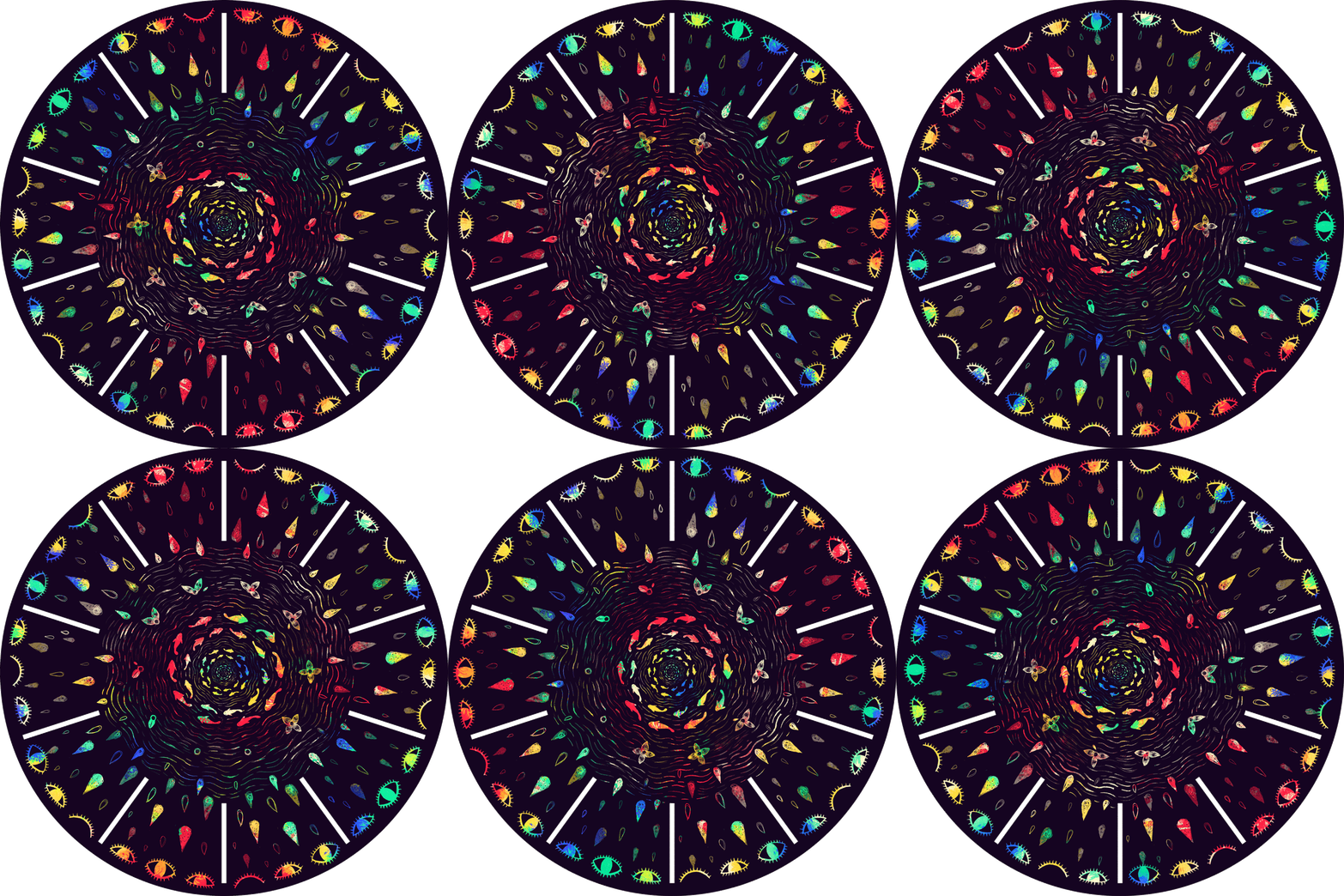
Arty Nicharee is a visual artist, maker, and creative facilitator.
Originally from Bangkok and now based in London, the artist and a graduate from the Royal College of Art uses illustration, graphics, and ceramics to trace the contours of memory, femininity, queerness, and the diasporic experience.
Arty Nicharee works in ceramics and visual practice. Her work is shaped by questions of cultural transmission, how meaning moves through objects, and what is lost or transformed when that movement crosses contexts.
Her recent work focuses on East and Southeast Asian material culture and the particular tension of objects whose significance is bound to ritual and place. When such objects enter a Western gallery, their meaning doesn't simply travel with them; it is renegotiated, often quietly, often without acknowledgement. Her practice sits inside that negotiation, not to resolve it, but to hold it open.
A related question runs through her making: whether durability and ritual function can coexist in the same object, or whether making the ephemeral permanent quietly surrenders the gesture. She works with hand-built forms that carry the trace of the hand precisely because the hand is part of what is being transmitted across cultures, across generations, across the distance between use and display.
Her recent work focuses on East and Southeast Asian material culture and the particular tension of objects whose significance is bound to ritual and place. When such objects enter a Western gallery, their meaning doesn't simply travel with them; it is renegotiated, often quietly, often without acknowledgement. Her practice sits inside that negotiation, not to resolve it, but to hold it open.
A related question runs through her making: whether durability and ritual function can coexist in the same object, or whether making the ephemeral permanent quietly surrenders the gesture. She works with hand-built forms that carry the trace of the hand precisely because the hand is part of what is being transmitted across cultures, across generations, across the distance between use and display.
Featured Work
‘House’ at County Hall Pottery
Group Exhibition at County Hall Pottery
This project explores the integration of Thai Malai, or traditional flower garlands, into a series of functional ceramic household objects. By reinterpreting the intricate form and deep cultural meaning of the Malai, I created a collection that brings a sense of warmth, respect, and vibrant energy into the domestic space, particularly during the colder, darker months.

Refrains On the Edge of Appearance

Refrains on The Edge of Appearance (or Refrains) is a group exhibition at outhouse gallery, featuring emerging and mid-career artists including Yadanar Aung, Lu Lei, Arty Nicharee, Aarti Pillai, Liszu Tan and Moses Tan. The exhibition presents a multidisciplinary dialogue of sculpture, performance, writing, moving image and textiles.
This project’s direction begins with Martinican poet and postcolonial theorist Édouard Glissant’s (1997) right to opacity, a strategy for resistance and solidarity amongst those who are routinely othered. Refrains examines this framework for relation through language—in its sound, text, narration, translation and censorship. Embracing illegibility over fluency, Refrains exhibits the experiences of artists from the Southeast Asian diaspora through fragments of clarity and noise. Each work carries a phantasmological
quality: sculpted, drawn, sewn or captured by hidden hands. Together, the artworks converse with one another across borders and tongues, embracing the multiplicities of national identity and lingua francas.
Entering the space, we are invited to attune ourselves to the reverberations of each work and recognise that there is more than what remains in the open. Rather than providing solutions, this project aims to create a temporary space for the construction of communal knowledge. The exhibition’s conversations expand through a series of intimate workshops, where visitors can rest and pause the impulse to grasp immediate
comprehension.
In a collective voice, we ask: In a contemporary (art) world obsessed with discovering the unseen, what is left? What forms of empowerment and political action might the hidden take? Outside of a colonial gaze that demands transparency, how do we listen to each other?
This project’s direction begins with Martinican poet and postcolonial theorist Édouard Glissant’s (1997) right to opacity, a strategy for resistance and solidarity amongst those who are routinely othered. Refrains examines this framework for relation through language—in its sound, text, narration, translation and censorship. Embracing illegibility over fluency, Refrains exhibits the experiences of artists from the Southeast Asian diaspora through fragments of clarity and noise. Each work carries a phantasmological
quality: sculpted, drawn, sewn or captured by hidden hands. Together, the artworks converse with one another across borders and tongues, embracing the multiplicities of national identity and lingua francas.
Entering the space, we are invited to attune ourselves to the reverberations of each work and recognise that there is more than what remains in the open. Rather than providing solutions, this project aims to create a temporary space for the construction of communal knowledge. The exhibition’s conversations expand through a series of intimate workshops, where visitors can rest and pause the impulse to grasp immediate
comprehension.
In a collective voice, we ask: In a contemporary (art) world obsessed with discovering the unseen, what is left? What forms of empowerment and political action might the hidden take? Outside of a colonial gaze that demands transparency, how do we listen to each other?
Selected Works
